Showing posts with label Church. Show all posts

Tuesday, November 9, 2010

Piazza Novona - Rome, Italy

A Balcony looking out onto Piazza Novona - Rome, Italy
A Balcony looking out onto Piazza Novona - Rome, Italy  

Piazza Novona, a ten minute walk from the pantheon, is probably Rome's most famous square. It actually sits on top of an ancient stadium built by Emperor Domitian in the first century AD. The track and field are said to have been used for competitions similar to the Greek olympics and during the Renaissance the stadium was often flooded for mock sea battles. 

More info and images after the jump.

Bernini's Fontana Quattro Fiumi in Piazza Novona - Rome, Italy

The square is also home to three famous fountains. The largest of these is Bernini's Fontana Quattro Fiumui (Fountain of the four rivers), shown above. The fountain is said to depict the four major rivers of the known continents: the Nile, the Ganges, the Plate and the Danube. Legend has it that the Bernini designed one of the statues (image below), facing the church of Saint Agnes (in the background of the image above), shielding his eyes from the "horror of the church" which was designed by his rival Borromini. In actual fact the church was built after the fountain.

Bernini's Fontana Quattro Fiumi in Piazza Novona - Rome, Italy

The solitary statue of Saint Agnes, above the facade of the church, turning away from Bernini's fountain when it would have normally faced the fountain. A small skull in the reliquary of the church is said to be that of Saint Agnes, who was beheaded in the stadium of Emperor Domitian in the 3rd century AD. 

Detail of Bernini's Fontana Quattro Fiumi in Piazza Novona - Rome, Italy

The other two fountains in the square are Fontana del Nettuno (Fountain of Neptune)  on the northern end of the piazza and Fontana del Moro (Fountain of the Moor) on the southern end. The Fontana del Moro, shown below, was designed by Giacomo della Porta consisted of a basin and four Tritons. In 1673 Bernini added a Moor (African) wrestling with a dolphin. 

Fontana della Moro in Piazza Novona - Rome, Italy

The basin of the Fontana della Nettuno was also designed by Giacomo della Porta in 1574 and is said to have been sponsored by Pope Gregory XIII.  For 300 years the fountain survived without any statues. The fountain we see today, with the statue of Neptune (shown below) was completed by Antonio della Bitta in 1878. 

Fontana della Nettuno in Piazza Novona - Rome, Italy

A number of restaurants open out onto the piazza which is also full of artist's stalls, street performers and tourists. Needless to say, it is quite crowded during the day. A Christmas market is held at the piazza  every year. The markets run well into the night and are said to be worth a visit. 

Tourists and the Church if Saint Agnes at Piazza Novona - Rome, Italy

All images on this post were captured with a Canon 7D and the 24 - 105mm lens.

A View of Piazza Novona - Rome, Italy

Thursday, November 4, 2010

Basilique du Sacre Coeur - Paris, France

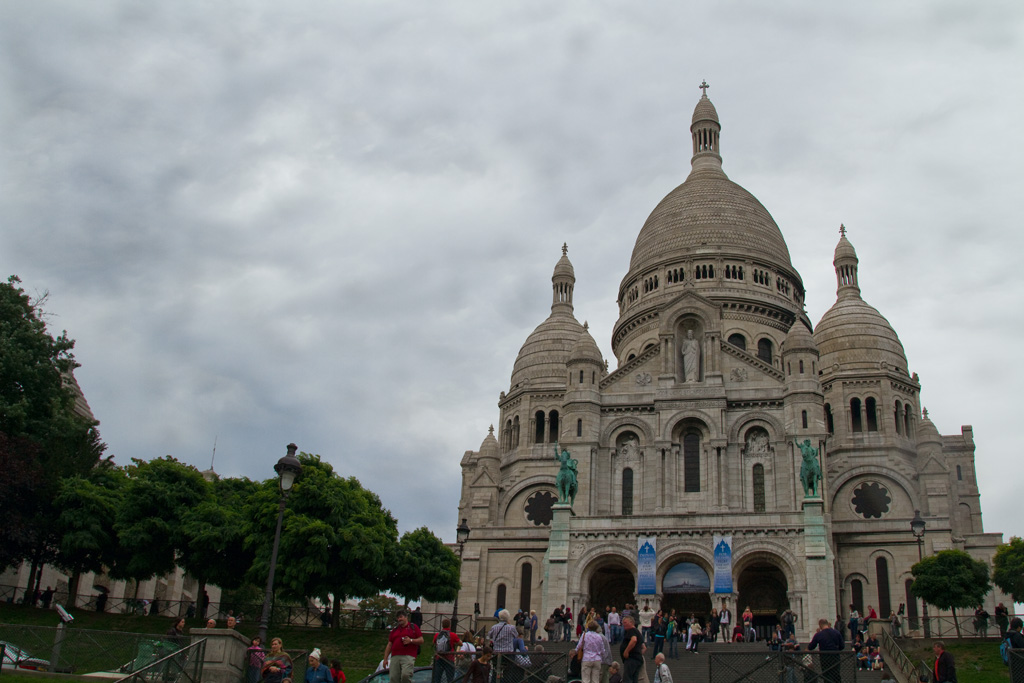
Sacre Coeur - Paris, France

The Basilique du Sacre Coeur (Basilica of the Sacred Heart) is a Roman Catholic church and one of the more famous landmarks of Paris. It's located in Montmartre, the highest point of the city. The church was built in 1875 on a site which has been associated with the beheading of Saint Denis, the patron of the city, in the 3rd century.  It is believed that the Basilica was dedicated to the 58,000 soldiers who lost their lives in the Franco-Prussian war. 

Read on for more images and info.

Sacre Coeur - Paris, France

The project was declared a "National Vow" by the church and was funded by Parishes throughout France.  An architect named Paul Abadie designed the basilica after winning a competition in which 77 other architects took part. The foundation stone is said to have been laid on the 16th of June 1875. Several attempts were made to stop the construction of the Basilica and it was once described as an "incessant provocation to civil war". One of these attempts led to the law passed in 1873 to acquire land for the site, being rescinded in 1882. Fortunately the church was saved by a technicality and the law was not reintroduced. 

Sacre Coeur - Paris, France

Abadie died soon after the foundation stone was laid and the work on the Basilica was carried out by 5 other architects. It was completed in 1914 but was not formally dedicated until 1919, after World War I. 

The Basilica is built out of Travertine stone quarried in Chateau-Landon in France. The stone constantly exudes calcite which ensures the Basilica remains white despite pollution and weathering. The two bronze statues at the entrance are of Joan of Arc and King Saint Louis IX.

A view of Paris from Sacre Coeur - Paris, France

The views of Paris from the forecourt and the tower are stunning. The view alone makes the climb to the top of the tower (around 300 steps) worthwhile. As with most of these monuments, it is not advisable to attempt the climb if you are claustrophobic.   

A panoramic view of Sacre Coeur - Paris, France

The first, third and fifth images on this post were on my shot list for Paris. I had to do a fair bit of research to identify a suitable and accessible location to photograph the Basilica from. It wasn't the easiest thing to do from Australia but with the help of a couple of photographers I was able to find a place. In order to get these shots, I carried the 100-400mm lens around Europe for a month! This was the only location I used it in.

Sacre Coeur - Paris, France

These images were captured with a Canon 7D and a combination of the 100-400mm and 24-105mm lenses.


Tuesday, September 28, 2010

Venice

A pickup point for Gondolas in Venice
A pickup point for Gondolas in Venice 

In this post, I thought I would concentrate on some of the things that we first noticed while wandering around the floating city - not so much the things that one thinks of as quintessentially Venetian, such as gondolas and Carnevale masks, which I will look at in more detail in later posts.

The image above is of the main Gondola "pickup point" at St Marks square. A 5.30am start was required to photograph the area around St Marks square without tourists walking into the frame. This area is unbelievably busy during "normal" hours of the day. The church in the background is San Giorgio Maggiore on the island of San Giorgio.

Read on for more info and images.

A Vaporetto navigates the Grand Canal

Venice consists of two main islands, which are divided by the Grand Canal, and a number of smaller islands. The Grand Canal, as the name suggests, is the main waterway used to get around. It starts in the Venetian lagoon and ends in St Marks Basin. The areas along the two banks of the Grand Canal are very touristy and full of restaurants and souvenir shops.

A Gondola glides along the Grand Canal

There are 4 bridges which span the Grand Canal. Of these the Rialto is the best known and the oldest - in fact, until the middle of the 19th century, this was the only bridge to span the Grand Canal. The Rialto is named after the market on eastern bank of the canal. It was initially a pontoon bridge built in 1181 by Nicolo Barettieri. Due to increased traffic the bridge was replaced by wooden bridge in 1255.  The wooden bridge burnt once and collapsed on two separate occasions, the last of which was in 1524. The stone bridge which stands today was built in 1591. It is constantly packed with tourists, either taking pictures, looking out over the Grand Canal or browsing around the two rows of shops which span the length of the bridge.

The Rialto Bridge
The Rialto Bridge

The Ponte dell' Academia is a relatively new wooden bridge across the Grand Canal. It is also the closest crossing to St Marks square. The entrance to the Gallerie dell' Academia is at the foot of this bridge on the eastern bank. The bridge offers two of the best views of Venice.

The Grand Canal photographed form the Academia Bridge

The islands of Venice are home to around 80 churches. Walking into most of these is like walking into small museums, as a number of them contain paintings and sculptures of the great Venetian artists including Tintoretto, Veronese and Titian.

>Santa Maria della Salute photographed from a Vaporetto
Santa Maria della Salute photographed from a Vaporetto

All these images were captured using a Canon 7D and a Canon 24-105mm Lens. I also had a circular polariser on the lens.

Tuesday, April 22, 2008

St Mary's Cathedral - High Dynamic Range


The ratio between the highest and the lowest values of a physical medium is referred to as "dynamic range". The dynamic range of a real world scene can be very high if the image, for example, includes a bright sky and dark shadows. Unfortunately cameras are unable to capture the whole range of such scenes.

In order to produce an image with the whole dynamic range of the scene, several photographs have to be captured at different exposure levels and merged together to produce an HDR image.

In order to produce the above image, i combined 5 photographs using Photomatix.